0.36 Kw Solar System Installation In Funyula Busia County, Kenya
Check out our recent 0.36 Kw Hybrid Solar System Installation in Busia County, Kenya
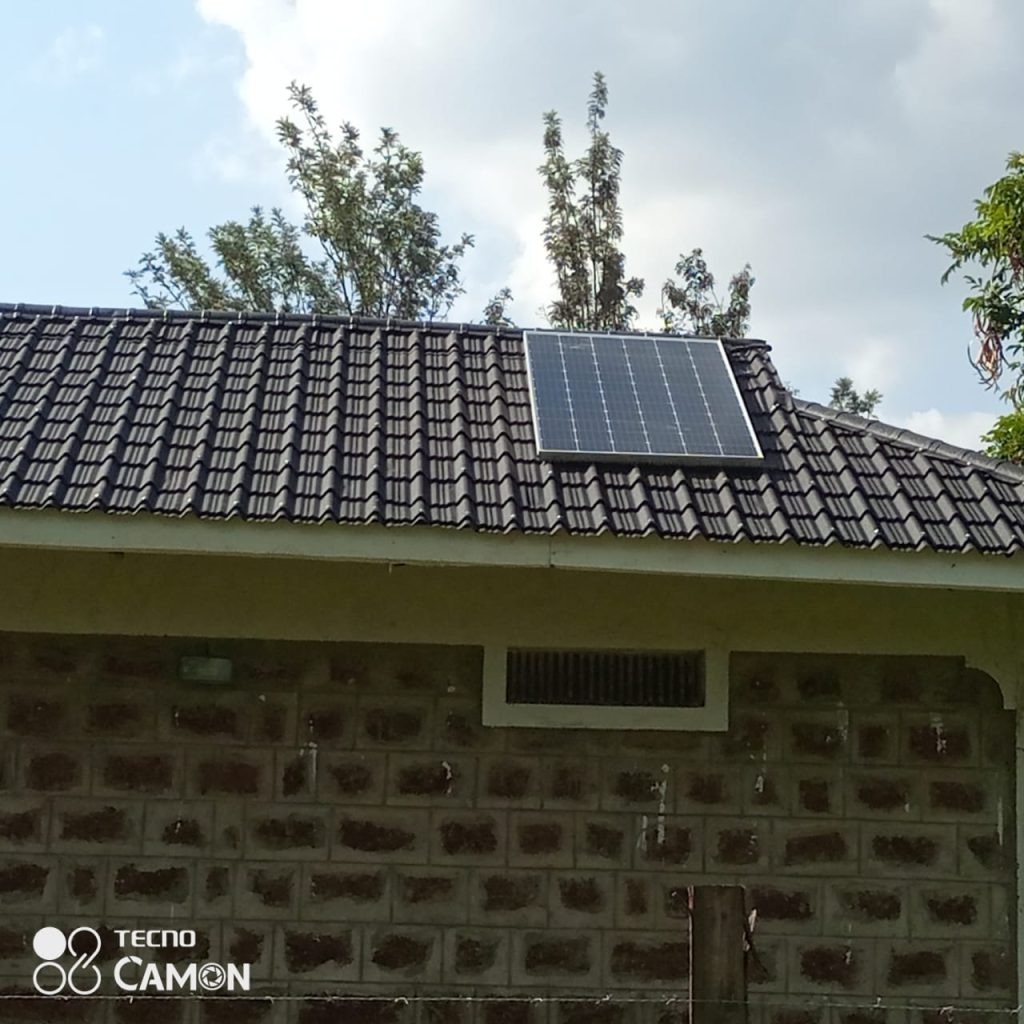

A recent 0.36 Kw Solar System Installation in Busia County, Kenya

Check out our recent 0.36 Kw Hybrid Solar System Installation in Busia County, Kenya
A recent 0.36 Kw Solar System Installation in Busia County, Kenya
Check out our recent 5.76 Kw Hybrid Solar System Installation in Migori County, Kenya
Contact Us For A Solar Quote in Your Area


Say you intend to install a 3Kw solar system but don’t have the full budget for installation upfront.
We always advise our clients to purchase a 3Kw hybrid inverter with foresight of upgrading their system with more panels and batteries for energy storage as funds become available.
This is a concept very similar to pay as you but at your own pace!
You can buy an extra solar panel or battery every 3 or 4 months until you complete building your 3Kw solar system.
If done in this way to avoid wastage of resources then, you don’t have to buy a 1 Kw Hybrid inverter then have to buy another inverter when funds are available for a 2Kw system as you continue to build your system towards your 3Kw solar system goal.
The one time purchase of the 3kw hybrid inverter will save you thousands in solar system upgrade costs.
Get an instant solar quote emailed to you here

Ever heard of a payment plan or layaway? Make payments at your own pace!
A question we always pose to our prospective clients is when was the last time you walked into a new car dealership and bought a vehicle cash?
Most of them replied they have never done so and due to the magnitude of financial commitment, they had to make payments.
With that answer in mind we demonstrated to them how they could afford the packages we offer by buying bits and pieces of the solar system at their pace.

Now that wasn’t so expensive after all was it? That’s the easy way to pay for our solar systems…
Get your FREE solar installation quote by clicking here today

Apart from doing an electronic energy audit, An accurately filled load profile form shows how much energy a building uses at each time of the day for each day of the year.
A completed solar load profile form is required,
To accurately determine the energy demand each client intending to make the switch to solar requires.
As a solar solutions provider, we would like to know how many lights,
Appliances and electronics you run in your house and how many hours during the day or night they are in use.
Clients who give inaccurate data end up having a solar system sized below their load energy demand.
Hence poor performance of their solar system.
Inaccurate load profile data leads to client complaints on why,
Their solar system shuts off very early during the night or trips during the day.
If you experience frequent water rationing in the city or town you live in, you’d agree that every time the city turns the water back on,
You rush to fill up your water tank as much as possible,
Knowing how long the stored water in the tank will last your household when,
The water gets turned off again by the city.
Say the stored water in the tank lasts you 4 days until the next time the city turns the water back on to refill the water tanks.
But on a rare occasion you had a party with guests over who spent the night and the water in the tank ended up lasting only 2 days.
The solution to fixing such a situation to never happen again is to buy a larger capacity water tank,
To cater for the days when you have visitors over or extra demand for water.
Same thing happens with solar systems,
The bigger the energy demand the bigger the energy storage system (battery bank) required,
To keep your loads powered through the night before they recharge again during the day.
In conclusion take a moment to fill out our online load profile form here to get your accurate solar quote today.
Consider reading: Load Shedding Best Practices For Solar Systems In Kenya
Looking for a solar system installer in Kenya? Check out our recent Solar System Installation Project in Syokimau, Kenya
Solar panel marketplaces consistently place LG solar panels in their top 10 lists, so it’s great to see that the company is continually working to improve its products. LG has unveiled two new solar panels and upgrades to its NeON module line for 2021.
LG’s new 66-cell NeON R and NeON R Prime modules are back-contact modules that will be available to U.S. homebuilders and homeowners this spring. The NeON R has a power output up to 440 W, while the NeON R Prime (all-black) rates at 425 W. Both modules have an efficiency up to 22.1%. Read more here and find out more about What To Look For When Comparing Solar Panel Prices in Kenya

Looking for a solar system installer in Kenya? Check out our recent Solar System Installation Project in Kitengela, Kenya
Looking for a solar system installer in Nairobi? Check out our recent Solar System Installation Project in Runda Nairobi, Kenya.

In 2007 when Gladys and I moved to Kenya, we bought this 150 watt solar panel and a battery at a cost of about $2,000. First it took Kenya Power and Lighting Company (KPLC) more than six months to connect the grid electricity to our house. When we were finally connected to the grid, one of the major problems was that there are outages perhaps five times per week. Some are short, but others last almost the whole day, and once we were three days without grid power. It is upsetting when you sit down to dinner and have the first bite almost to your mouth and the lights go out. This solar system is only sufficient to run the lights in the house and my laptop. So the grandchildren would have to run to turn off the refrigerator while I went in the dark to the disconnect box to switch from grid electricity and to the solar backup.
While in 2007 the 150 watt panel alone cost almost $1000, the 360 watt panels we just bought cost only $179.35 each. This illustrates the first of two trends that make it worthwhile to get a solar system. First, the cost of a solar system has gone down drastically in the last 13 years. Second, when we moved to Kenya the cost of electricity in Kenya was less than what we were paying at our house in the US. Over time, though, the cost of electricity kept rising in Kenya so now it is almost twice the amount per kilowatt hour what we would need to pay in the US. Recently KPLC announced another 20 percent price increase.
On March 30th, 2019, Clean Technica published my article The Best Summary Of Kenya Renewable Energy (& Dirty Energy) You Can Find (see here). Here is a quote from that article:
Since the equator runs right through the middle of Kenya and that much of the country is arid and semi-arid, one would assume that solar generation of electricity would be a no-brainer…Solar power potential in Kenya is enormous and their development is just beginning.
This is less than two years ago and currently solar energy installations are exploding. There are now small solar farms, companies are installing solar for the same economic and power outages that concern me, and roof top solar on residences are becoming common – one of our neighbors is just installing one on his new house. Partly as a result of this, KPLC has an excess of capacity which is one of the reasons that the cost of electricity continues to rise – due to contracts with providers, KPLC has to pay for generation of energy even if it is not used. This trend to install solar has alarmed KPLC (see here for a November 20th article Kenya Power raises alarm over clients solar switch) and there is legislation to make it harder to install solar. The government claims that helping KPLC to remain financially solvent is not the reason for these new regulations. Perhaps, but this is not going to stall the installation of solar systems in Kenya. KPLC will need to adjust.
When our monthly electricity bill continued to climb, we decided to explore a solar option for our house. By this time there are a number of solar power companies advertising in Kenya. I found three advertising on Facebook and emailed them about my interest in a solar power system. Two of the three never responded, but the third, Power Africa Solar (or its international name, PV Tech), immediately called. They sent me their information and I began to ask questions about what we were getting in to. Their customer service was superb. I mentioned to Gladys that this was the best company in Kenya that I had ever had dealings with. Do I need to say that KPLC is extremely difficult to deal with? Unfortunately my bubble burst when the solar system was installed and I was told that it is an American company (the head office is in Ontario, CA). Then when I looked up PV Tech on the internet (see here), I found that the company was mostly founded by Kenyans who had lived in America for a long time and had done well in the US corporate world. Many of the significant personnel in the Kenyan office are closely related to those founders in California. To get another bid, I went to a company in Eldoret that installs solar systems. For fewer panels their price was higher than the quote we had received from PV Tech. Moreover I didn’t have confidence that the salesperson was knowledgeable about home solar systems and giving me proper advice.
The system that PV Tech proposed and we accepted did not completely disconnect us from the grid. Those high consumption items – the electric oven, the electric burners on our stove (we mostly use the cooking gas burners on the stove), the instantaneous hot water heaters, and the Napier grass cutting machine – remain on the grid, while everything else including lights, laptop, TV, refrigerator, washing machine, iron, microwave, toaster, water pump, and other small appliances are on the solar system. The solar system will provide us with about 85 percent of our consumption. The system has six 360 watts solar panels, an inverter, and four 24 amp gel batteries that are supposed to last 15 years. I’ll let you know in 2035 if they have lasted fifteen years. The system cost $5519.18. I paid in US dollars since this saved us about $230. If there are no rate increases, it will take about 10 years to recover the cost. Since the local utility rates continue to increase, I assume that it will be more like 7 years to recoup the cost of the system. Note that my original small system is now over 13 years old.
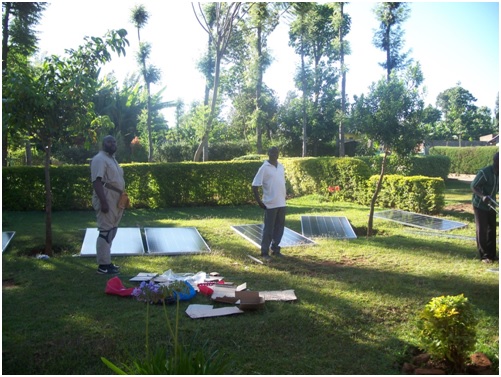
Thebeginning of the installation with the solar panels spread out on the lawn.

Chief technician, Francis Mukula, lifts the fifth heavy panel onto the roof for Julius and Mudavadi to secure to the roof.
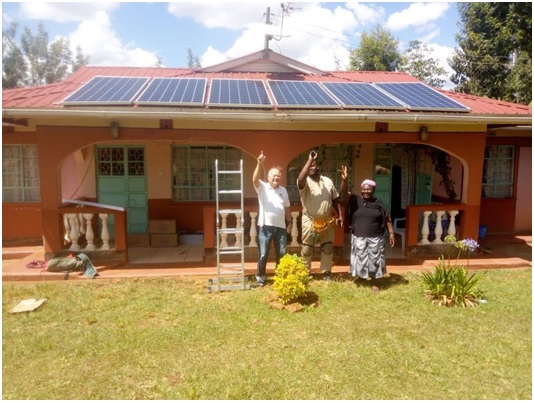
Gladys, Francis, and I are celebrating the installation of the six panels on the roof. Francis immediately posted this on Power Africa Solar’s facebook ad. It has 387 likes, 107 comments, and 41 shares. One of Gladys’ nephews saw the ad and commented on the installation. Here is one of the comments from this facebook ad, “Whenever I see solar panels I smile knowing very well that the despicable company by the name of KPLC has lost it big time and it’s pay back time.”
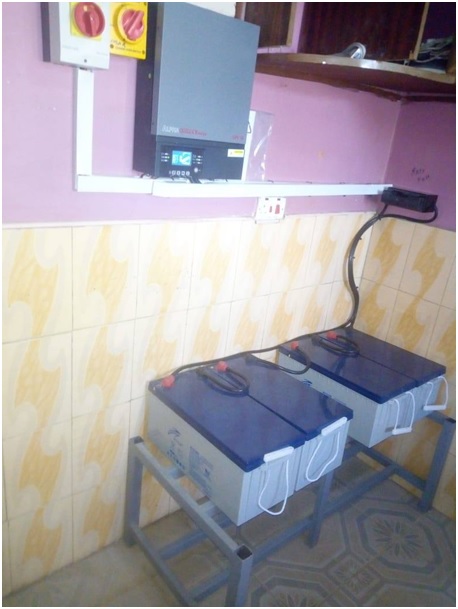
Here are the four batteries, the inverter, and on/off switches installed in our utility room.
So how is it working? Superbly. It has exceeded my expectations. One advantage I did not realize is that, if there is insufficient sunlight or we exceed our usual daily usage and the batteries become depleted, the inverter will automatically move us to grid electricity. So we will never be in the dark. Even though we have not yet hooked up the microwave and toaster to the solar system as we have to do some rewiring in the kitchen, it seems, as expected, that 85 percent of our electricity is being generated by solar. While the system runs on batteries at night, by noon or so the next morning, the batteries are fully recharged. I suspect that we are generating more electricity than we are using which means that the excess after the batteries are recharged are “wasted.” Then, again, this is part of the safety factor built into the system.
One thing our system does not do is decrease climate emissions much because 93 percent of Kenyan electricity on the grid already comes from renewable sources. We will install the 2007 solar system in our old house so that, when the grid is down, it can back up the lights there like it used to do in our present house.
I am well satisfied with our new solar power system.
High unpredictable electricity bills are increasingly putting a strain on Kenyans budgets.
The good news is…

The cost of switching to solar in Kenya has dropped significantly in the past several years. A decade ago, an average 1 kilowatt hour residential solar system could cost more than Ksh 1,000,000. Now, the outright cost of a typical home installation ranges from Ksh 300,000 to Ksh 360,000 which is a 64% average decrease.
From the price of hardware to ongoing maintenance, learn more about the cost of home solar.
It’s no secret that the energy costs in Kenya continue to rise to unpalatable levels.
Commercial and residential electricity rates (the amount you pay per kilowatt-hour, or /kWh) have constantly risen across the nation over the last 10 years. This trend is unlikely to be disrupted in the future: oil prices are only likely to increase, and as they do electricity rates will rise.
This cost will obviously be passed down to the consumers by the local power company.
Solar energy benefits businesses, organizations, and property owners in huge ways. Businesses all across Kenya, and the world are taking advantage of everything switching to solar has to offer.
Here’s an article we came across highlighting how high your electricity bill in Kenya could rise.

The Lawyer and Former Governor spend over Ksh 6,000,000 a year in electricity bills. Which is why Switching To Solar in Kenya is the Best Way to Reduce Or Eliminate Your Rising Power Bill.
In conclusion, Solar panels are rapidly spreading over Kenyan rooftops. And as the cost of solar continues to fall, it’s no surprise that residential solar systems are installed every 60 minutes in Kenya.
Residential solar costs are at their lowest in over 30 years. More affordable than ever, today’s residential solar panels feature technology advances that maximize power production. Read more on: How many solar panels will my home in Kenya need?